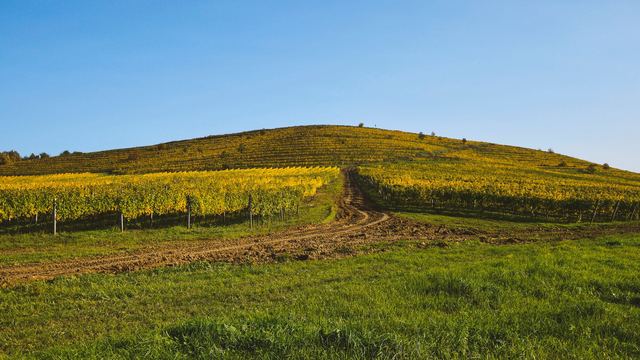
A Beaujolais wine tour is a day of wine tasting in the vineyards north of Lyon, where ten cru villages grow Gamay on granite. The region starts 50 km from the city, and the wineries that pour are working estates: you discover each wine beside the grower who made it.
What decides your day
- The cru villages sit 45 to 60 min north of Lyon by road; the golden stone country and its châteaux start 30 min out.
- Two or three wineries make a full day of wine tasting. A fourth is a queue, not a visit.
- A guided tour settles the driving question; a private wine tour lets you pick the domaine and the itinerary.
- Book ahead: most wineries close over lunch, and many are closed on Sunday.
What a Beaujolais wine tour actually covers
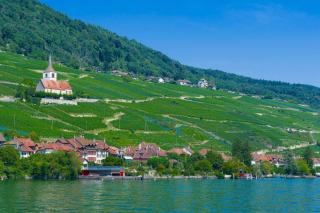
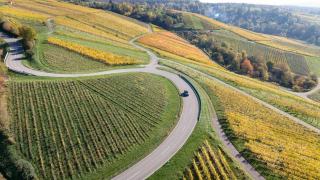
The Beaujolais wine region runs for roughly 55 kilometres between Lyon and Mâcon, on the western bank of the Saône. Its southern half, the Pierres Dorées, is built from a golden stone that turns the hamlets the colour of honey in late light. Its northern half holds the ten crus, the appellations that command shelf space abroad. A day tour that tries to cover both ends spends most of its time in a vehicle, which is why the better itineraries choose one half and stay there. Deciding which half to explore is the first question of any wine tour here, and the answer that looks most scenic is not always the one that pours the finest wines.
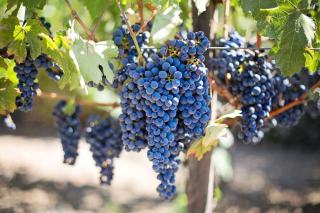
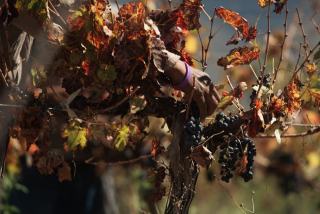
Gamay is the grape variety behind almost every red you will taste. It is picked by hand, a legal requirement across the appellation, and vinified by carbonic maceration or its semi-carbonic variant: whole bunches ferment inside their own skins before pressing, which is what gives young Beaujolais wines their red-fruit lift. The same grape on granite at Moulin-à-Vent gives something far more structured, closer in build to the reds of the neighbouring valley. Tasting the two side by side in one day is the single best argument for coming here rather than continuing north to the Burgundy vineyards and their Côte d'Or classifications.
The region was recognised as a UNESCO Global Geopark in 2018, a label that rewards geology rather than wine. It is a useful reminder of what you are looking at: the soil changes every few hundred metres, and the winemakers will talk about terroir in those terms long before they talk about vintages.
How far is the Beaujolais wine region from Lyon?
Villefranche-sur-Saône, the region's market town, is about 35 km from central Lyon. The cru villages are another 20 to 25 km beyond it, so a wine tour from Lyon means 45 to 60 min of road each way depending on which estate you start with. Trains reach Villefranche and Belleville in half an hour, but the domaines are scattered across hillsides that no timetable serves. Without a car, a guided tour or a taxi is the realistic answer.
The Lyon City Card covers transportation and museums inside the city and does not reach the vineyard, a detail worth checking before you assume your day is already paid for. Most operators include pick-up at your hotel or at a central meeting point, and drop-off at the same place; hotels in Lyon on the Presqu'île are the usual pick-up zone, and a pick-up further out may cost extra or may simply not be offered.
The ten crus, from Saint-Amour to Brouilly
The crus run from north to south. Saint-Amour is the northern end, Brouilly the southern, and the whole sequence fits inside about 20 km, which is why a single day can legitimately visit three of them. Régnié is the youngest, promoted in 1988; Chénas is the smallest; Chiroubles sits highest on the slope; Brouilly is the largest in planted area and wraps around the hill that gives Côte de Brouilly its name.
| Cru | Where it sits | What the wine tends to give |
|---|---|---|
| Saint-Amour | Northern tip, on the Mâconnais border | Light, floral, easy to drink young |
| Juliénas | Steep western slopes | Firmer, spiced, holds a few years |
| Chénas | Smallest of the ten | Dense, woody, often overlooked |
| Moulin-à-Vent | Around the old windmill, pink granite | The most structured, built to age |
| Fleurie | Under the Madonna chapel | Perfumed, silky, the crowd favourite |
| Chiroubles | Highest vineyard of the crus | Delicate, high-toned, early drinking |
| Morgon | Côte du Py, decomposed schist | Deep, savoury, the ageing benchmark |
| Régnié | Sandy granite, cru since 1988 | Supple, fruit-forward, good value |
| Brouilly | Largest cru, at the foot of the hill | Round, generous, widely poured |
| Côte de Brouilly | The blue volcanic slopes of Mont Brouilly | Tighter, mineral, the pair to taste together |
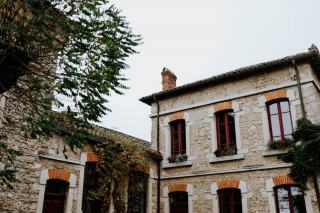
Mont Brouilly is also the one climb worth making on foot. Twenty minutes up from the parking and the whole vineyard opens out below, with the Alps on the eastern horizon on a clear day. Further south, the medieval town of Oingt, classified among the Plus Beaux Villages de France, is the postcard of the golden stone country and the obvious stop if you would rather explore architecture than cellars.
Guided tour, private wine tour or your own car
Three formats exist, and they are not interchangeable. The choice decides how much of the day you actually spend tasting.
The shared guided tour
A minibus leaves Lyon in the morning, visits two wineries, stops in a village, and returns mid-afternoon or early evening. You share the vehicle with six to eight other travellers, the local guide handles the appointments and the language, and nobody has to think about the drink-driving rules. It is the cheapest way to see the region with a guide, and prices are usually quoted per adult, in the low hundreds of EUR for a full day with lunch; every adult pays the same rate whatever the wineries selected, and a child travels at a reduced price. Pick-up and drop-off happen at a central point, the drop is at the same address in the evening, and an English-speaking guide is standard on departures sold abroad. Guided tours of this kind are the format most reviews describe, and the reviews on Tripadvisor consistently reward the guides who let the winemaker do the talking rather than performing themselves. Several agencies sell the same day as a gift, which solves the problem of choosing a date for another adult.
The private wine tour
A private tour puts a driver and a guide at your disposal for the day, which buys three things a shared departure cannot: you pick the domaine, you set the pace, and you keep the privacy of your own vehicle. Families, small groups and corporate events tend to land here. Expect to pay for the vehicle rather than per head, so the economics improve sharply from four people up. A private food and wine day, pairing a cellar visit with a Lyon food market or a bouchon table, is a common variant sold by the same operators.
Driving yourself
Self-drive gives the most freedom and the most responsibility. France applies a strict blood alcohol limit and the gendarmerie tests routinely on the D306 and the small roads between the crus, so one person keeps to spitting or the tasting stops. The practical arrangement is a designated driver, small pours, and a boot for what you buy. If you like the idea of stringing several regions together over a week, our guide to self-drive routes through the French wine country sets out the distances that work in a single trip.
Inside a tasting at a working domaine
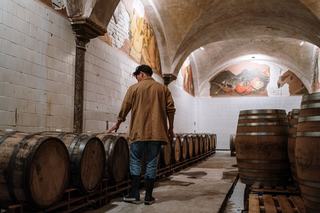
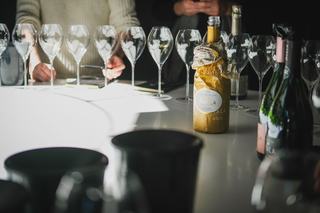
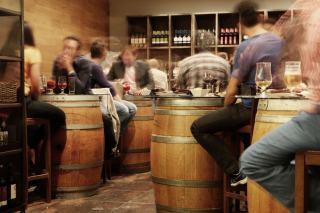
A tasting in Beaujolais is rarely a ticketed experience. You ring at a gate, someone puts down a tool, and the visit happens in the cellar or across a barrel. The rhythm is usually the same: a walk through the vats, four to six wines poured from the estate's range, and an invitation to buy that is offered rather than pressed. Allow an hour per estate, ninety minutes if the grower is talkative and the vineyard walk is included.
Fees are the part that surprises visitors. Many growers still pour without charge, treating the tasting as the cost of selling; others ask a modest amount per person, frequently deducted if you take a bottle home. The direction of travel across France is towards charging, and the amounts remain small here compared with Champagne, Burgundy or Bordeaux, where a structured tasting inside a château can cost several times more. A few EUR per person, refunded against a purchase, is the usual arrangement across the Beaujolais crus.
What to ask, if you want the visit to be more than a queue at a counter: which slope the fruit came from, how long the maceration ran, and whether the cuvée saw wood. Those three questions open the terroir conversation that every serious winemaker in the region is waiting to have.
Lunch, cheese and the Lyon food connection
Beaujolais is the cellar of Lyon, and the link between the two runs through the table. The bouchons of the city have poured these wines by the pot for a century, so a food and wine day here is not a marketing invention: it is the local habit. Most tours stop for lunch at a village restaurant, and that restaurant is usually the one the growers use themselves.
What lands on the plate is charcuterie, a hot sausage cooked in wine, and a cheese board drawn from the Saône valley. Look for a Saint-Marcellin or a fresh goat cheese from the hills: both are local specialties that a good restaurant serves at the right moment, neither too cold nor too firm. Say so when you book if you do not eat meat, because a rural restaurant in the crus may otherwise offer a single dish and no alternative.
For a complete immersion, some operators build a private food day around a Lyon food market in the morning and a cellar in the afternoon. It is the most enjoyable way to discover how the region eats and drinks as one subject, and the restaurant bill stays well below what the same meal costs in the city.
Booking: dates, prices and the cancellation policy
Booking a Beaujolais wine tour is straightforward, with two traps. The first is timing: growers are unavailable during harvest, absent during the spring fairs, and closed on Sundays more often than not, so check dates against the estate's own calendar and not only against the operator's availability grid. The second is the paperwork. Before you pay, the two pages that matter are the terms and conditions and the cancellation policy, not the privacy policy: weather cancellations, minimum group size and the refund window all live there.
- Lead time. A week is comfortable outside summer; from June to October, book two to three weeks ahead for a Saturday.
- Group minimum. Shared departures often need four people to run. A tour that is not confirmed 48 hours out probably will not run.
- Payment. Card payment is standard for the tour, but bring cash for small purchases at a domaine that has not moved to a terminal.
- Gift options. Several operators sell a gift card valid for a year, which is easier than guessing a date for someone else.
If you would rather build the day yourself, contact three wineries directly a fortnight ahead, space the visits at least two hours apart, and keep the last appointment before 17:00. A short message in French naming the date and the number of people is answered far more often than a booking form, and it lets you book the grower rather than a slot.
When to go, and what each season offers
There is no closed season, but the experience changes completely across the year.
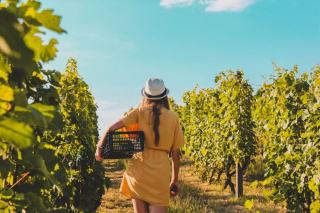
April to June gives green rows, open cellars and growers who have time to talk. June in particular is the month when the vineyards look their best, the tasting rooms are not yet crowded, and you can enjoy a slow discovery of the terroir at a winery with nothing else booked that afternoon. It is also the easiest moment to taste a Fleurie and a Morgon side by side without queueing. July and August bring heat and visitors; estates keep shorter hours and the middle of the day is uncomfortable on an exposed slope. September and early October are harvest, which means the most atmosphere and the least availability: growers are in the rows from dawn, and a tasting may be squeezed into twenty minutes between loads. If joining a picking team is the point of the trip, our page on the vendange and how to take part explains how the placements work.
November belongs to Beaujolais nouveau, released on the third Thursday of the month and celebrated across the villages through the following weekend. It is the loudest time to come, the least representative of what the crus do, and enormous fun if you take it for what it is. Winter empties the region entirely; a few domaines stay open by appointment, the cooperatives are closed more often than not, and you will taste alone, which some visitors enjoy more than any guided departure.
Wineries per day, crus versus Burgundy and English-speaking growers
How many wineries can you visit in one day?
Two in a half day, three in a full day. A fourth appointment turns the day into transport between car parks, and the tasting notes blur after the twelfth wine. Groups that want volume are better served by a single estate with a broad range than by four quick stops.
Is a Beaujolais wine tour worth it next to Burgundy?
For access, clearly. The great names of the Côte d'Or rarely receive individuals, while Beaujolais estates of real quality open their doors to anyone who writes ahead. You taste with the person who made the wine, at prices that still allow you to buy a case. The trade-off is prestige: the labels impress fewer people at home.
What does a full-day tour from Lyon usually include?
Round-trip transportation, two or three cellar visits with tastings, and a guide. Lunch is included on some departures and optional on others, and a restaurant table in a village is the common arrangement rather than a picnic. Wine purchases are always extra, and most operators will carry your boxes for the rest of the day.
Can you combine Beaujolais with the Rhône valley?
Not in one day. The northern Côtes du Rhône appellations start south of Lyon, roughly an hour and a half from the Beaujolais crus, so the two make an excellent two-day pairing but a poor single itinerary. The comparison between the granite Gamay here and Syrah on the southern slopes is worth the second day, and our page on wine tourism in the Rhône valley covers the appellations to prioritise.
Do the growers speak English?
In the cru villages, often enough to run a tasting; in the smaller family domaines, sometimes not at all. Guided departures from Lyon solve this by default. If you go alone, a few words of French and a willingness to point at the glass go a long way, and the wine itself is a shared language.