
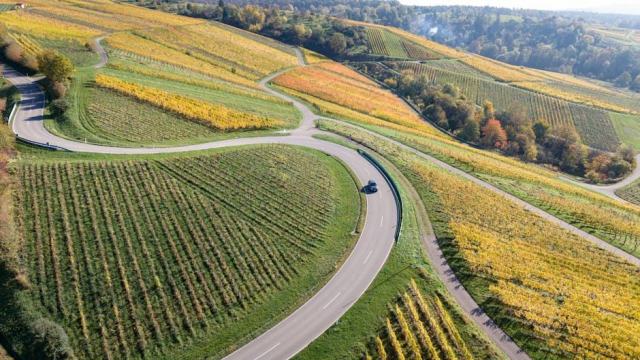
The easiest cycling wine tours France can offer start in the Loire Valley, where the Loire à Vélo path runs about 900 kilometres past vineyard after vineyard; Alsace, Burgundy and Bordeaux follow. A bike lets wine lovers explore the heart of each region and discover estates a short ride apart.
- Easy start
- Loire à Vélo: flat, signposted, with historic towns and local cellars.
- Famous and prestigious
- Burgundy from Beaune, Alsace around Colmar, Champagne houses, the Rhone.
- Pace
- 25 to 40 kilometres a day leaves time to enjoy guided or self-guided visits.
Why French wine regions suit a bike so well
French wine regions suit a bike because vineyards grow in tight belts along rivers and hillsides, so estates, villages and cellars sit a few kilometres apart. A cycle route that follows a river valley stays almost flat, crosses appellation after appellation and reaches a new village every half hour of easy riding. In Burgundy, the Côte d'Or packs the most prestigious villages of the region into a single strip of slope; in the Loire Valley, Sancerre, Vouvray, Chinon and Saumur line the same river.
The French cycle network has also grown fast. National and European routes such as EuroVelo 6, which follows the Loire, or ViaRhôna along the Rhône, give long signposted itineraries with surfaced paths, while regional authorities add smaller loops through the vines. Wine lovers gain something a car never gives: time. On a bike, you see the soil change, smell the cellar doors and stop when a hilltop village looks worth the climb. The pace forces fewer tastings per day, which tends to make each one more memorable.
A cycling holiday through French vineyards also fits travellers who do not ride much at home. Most of the classic routes avoid long climbs, e-bikes are easy to rent in every major wine region, and luggage transfer services carry bags from one hotel to the next. The effort stays light enough to enjoy the landscape, and the tasting still waits at the end of each stage.
The Loire Valley by bike, the gentlest way in
The Loire Valley by bike is the reference for a first cycling wine tour in France. The Loire à Vélo route, part of EuroVelo 6, follows the river for around 900 kilometres from Cuffy, near Nevers, to Saint-Brevin-les-Pins on the Atlantic coast, according to the route's official website. Most of it runs on dedicated paths or very quiet lanes, the signposting is continuous, and the gradient rarely matters except on the short climbs to hilltop vineyards.
Along the way, the Loire valley wine country changes every day of riding. Upstream, Sancerre and Pouilly-Fumé produce Sauvignon Blanc on chalk and flint. In Touraine, Vouvray and Montlouis face each other across the river with Chenin Blanc, while Chinon and Bourgueil make Cabernet Franc reds. Around Saumur, tuffeau cellars dug into the cliffs hold sparkling wine houses, and the last section towards Nantes crosses the Muscadet vineyards before the river reaches the ocean. The Loire appellations from Sancerre to Muscadet are described in more detail for travellers who want to choose their stretch by grape rather than by castle.
Which stretch of the Loire à Vélo to ride for wine
The stretch of the Loire à Vélo between Tours and Saumur concentrates the most wine and the most heritage in a few days of riding. It passes Vouvray just before Tours, then Chinon, the abbey of Fontevraud and the troglodyte villages carved into the tuffeau. Riders who want white wine above all can start further east around Sancerre, while a short loop from Nantes covers the Muscadet country in a weekend. Each option works as a linear trip with luggage transfer, or as a series of day rides from a single base in a historic town such as Amboise or Saumur.
The Accueil Vélo label, a national quality mark, identifies accommodation, bike hire shops and tourist sites near the route that welcome cyclists with secure bike parking and repair tools. Many wine estates along the river belong to it, which makes it easy to plan stops where a bike is expected rather than tolerated.
Alsace, a wine route made for cycling
The Alsace wine route is one of the most famous wine trails in France, running about 170 kilometres from Marlenheim, west of Strasbourg, to Thann in the south. Cyclists rarely follow the road itself: a signposted cycle route through the vineyard, the Véloroute du Vignoble d'Alsace, runs parallel to it on vineyard tracks and small roads, linking villages such as Riquewihr, Kaysersberg, Ribeauvillé and Eguisheim.
Alsace rewards cyclists with short distances between stops. Half-timbered villages sit two or three kilometres apart, family estates open their tasting rooms on the main street, and the region counts 51 Grand Cru appellations, each tied to a named slope. The terrain is gently rolling at the foot of the Vosges: a few climbs separate the villages, which makes an e-bike welcome for occasional riders. Colmar, often called the capital of Alsace wines, makes a good centre for a loop holiday, with day rides north towards Riquewihr and south towards Eguisheim. The choice between a guided wine tour and driving yourself applies here too, since several local operators run guided cycling days with pre-booked cellar visits.
Burgundy by bike and the Voie des Vignes
Burgundy by bike means riding through some of the most prestigious vineyards in the world at walking speed. The Route des Grands Crus links Dijon and Santenay through the Côte de Nuits and the Côte de Beaune, passing Gevrey-Chambertin, Vougeot, Nuits-Saint-Georges, Aloxe-Corton, Pommard, Volnay and Meursault. The Climats of the Burgundy vineyards, the small named plots that structure the region, were inscribed on the UNESCO World Heritage List in 2015.
The Voie des Vignes is the cycle path that makes this landscape easy to explore. It runs from Beaune to Santenay on a dedicated track between the vines, then connects with the greenway towards Chalon-sur-Saône and the wider Burgundy cycle network. Beaune, with its historic Hospices and its many wine merchants, is the natural base: hire shops in the town centre rent classic bikes and e-bikes with route maps. North of Beaune, the Côte de Nuits section uses minor roads rather than a separate path, and the slope between village and hillside adds a few short climbs.
Burgundy wine trails are also the place where appointments matter most. Many prestigious domaines receive visitors only by reservation, and some do not open at all. A cycling route through the Côte d'Or works best when it mixes a booked visit or two with the cellars of négociants in Beaune and Nuits-Saint-Georges, which keep regular opening hours.
Bordeaux and the Entre-Deux-Mers on two wheels
Bordeaux offers a different cycling experience from the Loire or Burgundy: wide estates, grand châteaux and a vineyard spread across both banks of the Garonne and Dordogne. The easiest cycle route is the Roger Lapébie path, a former railway line converted into a greenway that leaves the outskirts of Bordeaux and crosses the Entre-Deux-Mers towards Sauveterre-de-Guyenne. The gradient stays gentle along the old track, and side roads lead to estates producing white Bordeaux and Entre-Deux-Mers wines.
Saint-Émilion, whose wine jurisdiction was inscribed by UNESCO in 1999, makes a rewarding but hillier destination: the medieval town sits on a limestone plateau, and the surrounding lanes climb between the vines. The Médoc, north of Bordeaux, is the opposite: flat, open roads past the famous châteaux of Margaux, Pauillac and Saint-Julien, with longer distances between stops. Riders who like to enjoy a city as well can combine a few days of cycling in the vineyard with a stay in Bordeaux itself, one of the most bike-friendly cities in France.
Champagne, the Rhône and the Canal du Midi
Champagne is the region where cycling meets the most famous sparkling wine. Épernay, with its Avenue de Champagne lined with the great houses, sits at the meeting point of the Montagne de Reims, the Côte des Blancs and the Marne valley. The Champagne hillsides, houses and cellars were inscribed by UNESCO in 2015, and the Tour de France finished a stage in Épernay in 2019. The towpath along the Marne is flat, while the routes up the Montagne de Reims and through the Côte des Blancs villages, such as Cramant and Le Mesnil-sur-Oger, include real climbs.
The Rhône valley is crossed by ViaRhôna, a cycle route of more than 800 kilometres from Lake Geneva to the Mediterranean. Its northern section passes the steep terraces of Côte-Rôtie, Condrieu and Hermitage, where the vineyard rises directly above the river; further south, a detour leads to Châteauneuf-du-Pape. In the Languedoc, the towpath of the Canal du Midi, a UNESCO site since 1996, links Toulouse with the Étang de Thau near Sète through a rich wine country. Parts of the towpath remain unpaved, so a hybrid or gravel bike is a better choice than a road bike there.
| Region | Main cycle route | Terrain | Wines met on the way | Good base |
|---|---|---|---|---|
| Loire Valley | Loire à Vélo (EuroVelo 6) | Flat, riverside paths | Sancerre, Vouvray, Chinon, Saumur, Muscadet | Amboise, Saumur |
| Alsace | Véloroute du Vignoble d'Alsace | Rolling, short climbs | Riesling, Gewurztraminer, Pinot Gris, 51 Grands Crus | Colmar |
| Burgundy | Voie des Vignes, Route des Grands Crus | Gentle south of Beaune, hillier north | Pinot Noir and Chardonnay of the Côte d'Or | Beaune |
| Bordeaux | Roger Lapébie greenway | Flat greenway, hills at Saint-Émilion | Entre-Deux-Mers, Saint-Émilion, Médoc | Bordeaux, Saint-Émilion |
| Champagne | Marne towpath and vineyard loops | Flat valley, steep hillsides | Champagne of the great houses and growers | Épernay |
| Rhône valley | ViaRhôna | Flat by the river, terraces above | Côte-Rôtie, Condrieu, Hermitage | Tain-l'Hermitage |
What to expect on a cycling wine tour, hour by hour
A cycling wine tour in France usually follows a calm rhythm: a morning ride, a cellar visit before lunch, a long lunch in a village, a shorter afternoon ride and a last tasting near the evening stop. Estates often close between noon and two o'clock, and family domaines expect visitors by appointment, so the day is built around two or three tastings rather than five or six. The wider guide to wine tourism in France shows how the same rhythm applies to other ways of visiting.
Riders should expect varied surfaces. Greenways along rivers and old railways are smooth, vineyard tracks can be gravel, and the last kilometre to a hilltop estate is often the steepest of the day. The weather counts too: summer heat in the south and the Rhône valley makes early starts wiser, while spring and autumn bring cooler temperatures and, in September and October, the harvest. Local wine tasting during the harvest is lively, but some smaller producers have less time for visitors during those weeks.
Most of the cycling wine tour experience happens off the bike: the conversation with a grower about the soil, the walk through a cellar dug into the rock, the picnic at the end of a vineyard row. Those moments make a route memorable more than the number of kilometres ridden.
Lunch is often the unique moment of the day on a vineyard ride. Village bistros in the heart of Burgundy, Alsace winstubs and riverside guinguettes along the Loire serve regional dishes with local bottles by the glass, which lets riders taste a wider range of wines without opening a full bottle. Booking a table in summer avoids arriving hungry at a full restaurant after a morning in the saddle, especially on Sundays, when many village restaurants fill with families. Picnics are another option: bakeries, cheese shops and weekly markets in towns such as Beaune, Chinon or Riquewihr sell everything needed for a meal among the vines, and many estates tolerate a picnic at the edge of their plots when visitors ask first.
Evenings matter as much as the stages. Staying in a wine village rather than a larger town lets riders discover the place after the day visitors leave, walk to a last tasting without the bike and talk with growers who finish their own work late. Some estates rent rooms or gîtes on the property, which turns the final stop of the day into the accommodation itself and removes any question about riding after a tasting. A rest day in the middle of a longer trip leaves time to explore a historic town on foot, visit a wine museum or simply enjoy a terrace without counting kilometres.
Guided cycling wine tours or a self-guided trip?
Guided cycling wine tours suit travellers who want every cellar visit booked and a guide to explain the wines, while a self-guided trip suits those who like to set their own pace with a route already prepared. Between the two, many operators sell self-guided packages with hotels, bikes, luggage transfer and a GPS route, but no guide on the road. The table compares the three formats on what changes for the rider.
| Format | Who plans the route | Tastings | Suits |
|---|---|---|---|
| Guided group or private tour | The operator, with a guide riding along | Pre-booked, often with access to estates closed to the public | First visits, prestigious domaines, short stays |
| Self-guided package | The operator, delivered as maps and GPS tracks | Suggested, sometimes pre-booked | Couples and friends who want freedom without logistics |
| Fully independent trip | The rider | Booked directly with each estate | Experienced cyclists, French speakers, flexible travellers |
The level of comfort matters as much as the format. Packages usually come in several categories, from guesthouses to château hotels, and the choice of accommodation changes the trip more than the route itself. Travellers who book independently should reserve early in summer along the Loire and in Alsace, where the best-placed rooms fill up months ahead.
Bike hire for wine tours: what to rent and where
Bike hire for wine tours is available in every major French wine region, from small local shops to networks that let riders pick up a bike in one town and drop it in another. On the Loire, networks such as Détours de Loire operate several agencies along the river, which suits a linear trip. In Beaune, Colmar, Épernay, Tours and Saumur, hire shops rent classic bikes, e-bikes and tandems by the day or the week, often with panniers, a lock, a repair kit and a route map.
Classic bike, e-bike or gravel bike
The right bike depends on the terrain more than on fitness. A classic hybrid bike is enough for the Loire à Vélo, the Marne towpath or the Roger Lapébie greenway. An e-bike makes Alsace, the Côte de Nuits, the Montagne de Reims and Saint-Émilion much easier, and lets a mixed group ride together whatever their level. For the unpaved sections of the Canal du Midi towpath, wider tyres or a gravel bike avoid a tiring ride. Riders bringing their own bike can use the bike spaces on many regional trains, which helps to return to the starting point of a linear route.
Bike rental services and what to check
Before renting, check what the bike rental includes: helmet, panniers, lights, a phone holder for GPS, and assistance in case of a puncture or breakdown. Luggage transfer is usually sold separately by tour operators and some hire networks. For a multi-day ride, ask whether the shop can deliver the bikes to the hotel and collect them at the end, which saves a trip back with tired legs.
How many days for a cycling wine tour in France?
The ideal duration for a cycling trip through French vineyards is four to seven days for a first tour. Three days are enough to discover one area at a relaxed pace, such as the Côte de Beaune or the villages around Colmar. A week allows a full section of the Loire à Vélo, or a combination of Burgundy and the Beaujolais to the south. Beyond ten days, riders can link two regions, for instance the Rhône valley and Provence, or continue along the Loire to the Atlantic.
Daily distance decides how many days a route needs. Riders who plan 25 to 40 kilometres a day keep time for two or three tastings, a long lunch and a visit to a historic town; 50 to 60 kilometres a day suits keen cyclists but leaves less time in the cellars. Leaving one day without a fixed stage helps to absorb bad weather, an unexpected invitation from a grower or simply tired legs. Recommended days cycling are therefore always a little more than the map suggests.
Bottles on a bike: buying wine without carrying it
Buying wine on a cycling tour raises a practical question that car travellers never face: where to put the bottles. A pannier holds a few bottles at most, adds weight on the climbs and exposes the wine to heat and vibration. Many estates ship purchases to the traveller's home, in France or abroad, and some operators collect bottles with the luggage transfer each evening. Asking about shipping before tasting avoids buying more than the bike can carry.
For travellers flying home, shipping often turns out simpler than packing bottles in a suitcase, and it avoids fragile parcels on a bike rack. When bottles do travel on the bike, wrapping them in clothing, placing them low in the panniers and keeping them out of the afternoon sun protects both the wine and the rider's balance. A few estates also sell half bottles, which fit a picnic better than a full bottle.
Tasting and riding under French road rules
Tasting and riding are governed by the same law as driving: under the French highway code, a bicycle is a vehicle, and the blood alcohol limit for motorists applies to cyclists as well. Riding over that limit is an offence punished by a fine, and a road safety leaflet published by the Haute-Vienne prefecture states that cycling after drinking is no more permitted than driving any other vehicle. The same leaflet reminds cyclists that headphones and earpieces are banned while riding. The French drink-driving limit and how it is checked applies on every wine route, including vineyard tracks open to traffic.
On a wine tour, the practical answer stays simple: use the spittoon, which growers expect and respect, keep the longest tasting for the last stop of the day close to the accommodation, and drink water between visits. Guided tours often plan the most generous tasting at the end of the stage for that reason. Riding at dusk without lights after a long lunch is the situation to avoid; a reflective vest is compulsory outside built-up areas at night or in poor visibility.
Best season for cycling through vineyards
The best season for cycling through vineyards in France runs from May to early October. In May and June, the vines flower, the days are long and the summer crowds have not yet arrived. July and August bring heat, especially in Bordeaux, the Rhône valley and the Languedoc, and busy cycle paths along the Loire. September and early October offer the harvest, golden light and cooler riding, but some estates reduce their opening hours while they pick.
Winter is possible in a few places, mainly for short day rides around Beaune, Colmar or Épernay, where wine houses and merchants keep their cellars open. Many hire shops and some cycle-friendly accommodation close between November and March, so a winter trip needs more planning than a summer one. Each season gives the same landscape a different colour, and returning riders often choose a second trip at another time of year to see it change.
Cycling wine tours in France: questions riders ask before booking
Do you need to be fit for a cycling wine tour?
A cycling wine tour in France does not require special fitness on the flat routes: the Loire à Vélo, the Marne towpath and the Roger Lapébie greenway suit anyone who rides a bike occasionally. Hillier regions such as Alsace, the Côte de Nuits or Saint-Émilion are easier on an e-bike, which most hire shops rent.
Can you visit wineries without an appointment on a bike?
Some wineries welcome cyclists without an appointment, especially merchants and cooperatives in Beaune, Colmar, Saumur and Épernay. Family domaines and prestigious estates usually expect a booking, so calling a day or two ahead keeps the route smooth.
Which region is best for a first cycling wine tour in France?
The Loire Valley is the best region for a first cycling wine tour in France: the route is flat and signposted, bike hire is easy, and wine villages, castles and accommodation sit close together along the river.

