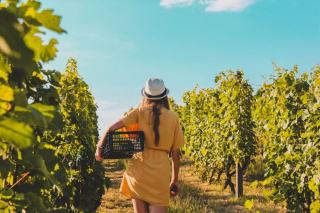

To visit Champagne vineyards, pair a guided cellar tour at a Champagne house, one of the best in Reims or on the Avenue de Champagne in Épernay with a Champagne tasting at a grower of the Montagne de Reims. The Champagne region lies 45 minutes from Paris by TGV: a day trip from Paris to the vineyards fits two wine tasting tours.
- Champagne houses to visit
- Ruinart, Taittinger and Pommery in Reims; Moët & Chandon, Mercier and Perrier-Jouët in Épernay, each with a cellar tour and a tasting.
- Grower visits
- A Champagne grower (RM on the label) tastes Pinot Noir and Pinot Meunier wines with you: contact them to book the visit.
- Best time to visit
- Spring and the autumn months for a quieter wine region; the harvest for atmosphere, with fewer guided tours at small houses.
What makes the Champagne vineyards different from other French wine regions?
The Champagne vineyards cover a narrow strip of chalk and clay hillsides in the north-east of France, mostly in the Marne department, with a southern outpost in the Aube known as the Côte des Bar. The climate is cool and the soil is chalk, and both shape the wine: high acidity in the grapes, and underground galleries that keep a steady temperature all year round. Those galleries are the reason a visit here looks so different from a visit to Bordeaux or the Loire. In Reims, several houses age their bottles in crayères, chalk pits dug in Gallo-Roman times and later turned into cellars; in Épernay, kilometres of tunnels run beneath the Avenue de Champagne.
In July 2015, UNESCO added the "Champagne Hillsides, Houses and Cellars" to the World Heritage List. The listing covers three sites: the historic hillsides of Hautvillers, Aÿ and Mareuil-sur-Aÿ, the Saint-Nicaise hill in Reims with its crayères, and the Avenue de Champagne in Épernay. A first trip that touches all three gives a complete picture of how sparkling wine production grew from a village craft into a global trade. The region also keeps a strong link with French history: kings were crowned in Reims cathedral, and the basilica of Saint-Remi, listed by UNESCO in 1991 with the cathedral and the Palace of Tau, stands a short walk from the crayères of the big houses.
Which grape varieties will you taste on a Champagne tour?
Three grape varieties make up almost all of the champagne production you will taste: Pinot Noir, Pinot Meunier and Chardonnay. Pinot Noir dominates the Montagne de Reims and the Côte des Bar and gives structure and red-fruit notes. Pinot Meunier, more at home in the Vallée de la Marne, gives rounder, fruit-forward wines that open early. Chardonnay rules the Côte des Blancs and gives the finesse and citrus tension found in a blanc de blancs. A blanc de noirs comes only from the two black grapes, and a rosé champagne is often made by blending a little still red wine with white, a method the appellation allows.
The appellation rules also name 17 villages as grand cru, among them Aÿ, Bouzy, Ambonnay, Verzenay, Cramant, Avize and Le Mesnil-sur-Oger, and a longer list of premier cru villages. On a tasting tour, comparing a grand cru blanc de blancs from Cramant with a Pinot Noir from Bouzy teaches more about terroir than any brochure. The same goes for the dosage, the small amount of sugar added after the second fermentation: extra brut, brut and demi-sec taste very different, and guides at the larger houses usually explain the scale during the visit.
Exploring the region by sub-area
The Champagne wine region splits into four main areas, each with its own grape, its own villages and its own style of visit. Reading the map this way helps when you choose where to stay and how many cellars fit into one day.
| Area | Main grape | Villages to know | Type of visit |
|---|---|---|---|
| Montagne de Reims | Pinot Noir | Verzenay, Bouzy, Ambonnay, Rilly-la-Montagne | Forest walks, the Verzenay lighthouse museum, grand cru growers |
| Vallée de la Marne | Pinot Meunier | Hautvillers, Aÿ, Mareuil-sur-Aÿ, Cumières | UNESCO hillsides, Dom Pérignon's abbey, river views |
| Côte des Blancs | Chardonnay | Cramant, Avize, Oger, Le Mesnil-sur-Oger | Blanc de blancs tastings at family estates |
| Côte des Bar (Aube) | Pinot Noir | Les Riceys, Essoyes, Urville | Quieter roads, Renoir's house in Essoyes, rosé des Riceys |
The signposted Champagne tourist route links these areas with marked loops, so a driver or a cyclist can follow it village by village. The Côte des Bar sits about an hour and a half south of Épernay by car, which is why most travellers keep it for a second trip or a longer stay.
What are the best Champagne houses to visit in Reims and Épernay?
Reims holds many of the most renowned Champagne houses, and several of them guide visitors through crayères that are worth the trip on their own. Ruinart, founded in 1729 and often described as the oldest house still operating, ages its wine in chalk pits classified as a historic monument. Taittinger runs a cellar tour beneath the Saint-Nicaise hill, partly in the remains of a medieval abbey. Pommery, Veuve Clicquot, Mumm and Lanson complete the list of iconic names that offer guided tours, usually with a tasting at the end, and the reasons behind what French wineries charge for a tasting explain why the formats differ so much from one house to the next.
Épernay is the second pole, and the Avenue de Champagne is where to explore the city on foot: Moët & Chandon, Perrier-Jouët, Pol Roger and the Maison Mercier, whose visit includes a small train through the cellars, all line the same street. De Castellane, with its tower overlooking the town, and Leclerc Briant, known for its biodynamic approach, add variety. Outside the two cities, Laurent-Perrier welcomes visitors at Tours-sur-Marne, and Hautvillers keeps the abbey church where Dom Pérignon, the Benedictine monk whose name later became a prestige cuvée, worked as cellarmaster until his death in 1715.
A good rule for a first trip is one major house in the morning and one smaller producer in the afternoon. Big houses show the scale of the trade and the technical side of the traditional method; a grower shows the vineyard, the press and the family behind the label.
Major houses, growers and cooperatives: who you are visiting
Every bottle of champagne carries a small two-letter code next to its registration number, and that code tells you what kind of producer you are about to visit. Learning to read it before the trip helps you choose between a polished house tour and a kitchen-table tasting.
| Code | Producer type | What the visit looks like | How to book |
|---|---|---|---|
| NM | Négociant-manipulant: a house that buys grapes as well as growing them | Scheduled cellar tours in several languages, a museum or film, a tasting room | Online booking, weeks ahead in summer |
| RM | Récoltant-manipulant: a grower who makes wine only from their own vines | A walk in the vines, the press house, a tasting with the family | Email or phone contact a few days before |
| CM | Coopérative de manipulation: a cooperative making wine for its member growers | A shop and tasting counter, sometimes a short cellar visit | Often open without booking during shop hours |
Growers rarely have staff dedicated to visitors, so the person who opens the door is often the winemaker. That makes contact before the visit essential: a short email saying when you plan to arrive, how many people you are and which language you speak is enough.
How to plan a Champagne vineyard trip from Paris
A Champagne trip from Paris works well by train, because the TGV from Paris-Est reaches Reims in about 45 minutes and regional trains continue to Épernay. With a car, the A4 motorway serves both towns. A single outing can cover Reims alone, with two cellar tours and the cathedral; a weekend allows a morning in Reims and another on the Avenue de Champagne in Épernay, with an afternoon among the growers of the Vallée de la Marne.
Driving between estates raises a practical point: in France the legal blood alcohol limit is 0.5 g per litre, and 0.2 g for drivers in their probationary period. Using the spittoon at each tasting, choosing a designated driver or joining an organised tour keeps the day safe. A guided option also solves the question of access to small producers, since local guides know which growers receive visitors on a given day. The way a guided wine tour in France is organised and priced varies from a shared minibus to a private driver-guide.
A realistic rhythm is two or three visits per day, with lunch in a village between them. Many family producers close at midday and some close on Sundays, so the afternoon slot needs checking.
When is the best time to visit Champagne vineyards?
The best time to visit Champagne vineyards depends on what you want to see. Spring months, from April to June, bring green vines, mild weather and open doors at most cellars, without the summer crowds. July and August are the busiest weeks at the large houses, and weekend tours can be full well in advance. The harvest, which in recent years has often started at the end of August or in early September, is the most atmospheric period: pickers fill the hillsides and the presses run day and night. It is also the period when small growers have the least time for visitors.
The autumn months after the harvest, in October and November, are a good compromise to avoid crowds: the vines turn gold, the new wines are fermenting and growers have more time to talk. Winter is quiet, cellars stay at the same temperature whatever the weather outside, and the big houses in Reims and Épernay keep running tours, though on reduced schedules.
Booking a cellar tour and what to expect underground
To book champagne visits at the large houses, the official website of each house is the most reliable route: it lists the tour formats, the languages and the days of opening. Booking websites for winery tours and regional platforms can help compare several houses on one page, but checking the conditions with the house itself avoids surprises. For growers, a direct contact by email or phone remains the norm; the steps for booking a French winery visit, region by region apply here too.
A typical cellar tour at a major house lasts about an hour. It starts with the history of the house, goes down into the galleries, where the temperature stays close to 10 to 12 °C, and explains riddling, the slow turning of bottles that brings the yeast deposit to the neck, before disgorging. The visit ends with a tasting of one or several cuvées, and premium formats add older vintages or a prestige cuvée. A warm layer is useful even in summer, and comfortable shoes help on wet steps. At growers, the experience is less scripted: you may see the press, the vats and the vineyard, then taste the range with the person who made it.
Tasting fees follow the same split. Large houses such as Pommery or Taittinger charge for their tours, with several levels depending on the cuvées poured, while growers may offer a tasting free or deduct the fee from a purchase.
Discover the villages between two cellar visits
The villages of the Champagne vineyards deserve time of their own, because the landscape tells the story of the wine as well as any guide. Hautvillers, perched above the Marne, has wrought-iron signs that show the trade of each household and a view across the UNESCO hillsides. Verzenay is known for its lighthouse in the middle of the vines, which now houses a museum about the vineyard and its seasons. Aÿ hosts some of the oldest family houses of the region, and the Côte des Blancs villages, Cramant and Avize first among them, line up along a single slope of Chardonnay.
Walking and cycling routes cross the vineyards between these villages, and the Montagne de Reims regional nature park offers forest trails, including the twisted beech trees of Verzy, known as the Faux de Verzy. Stopping for lunch in a village restaurant, where the local still wine Coteaux Champenois may appear on the list, gives a fuller taste of the region than a day spent only underground. For travellers who want to stay among the vines, the Royal Champagne Hotel & Spa at Champillon and smaller guest houses run by grower families offer two very different ways to spend the night in the vineyards.