
Wheelchair accessible winery tours in France are guided vineyard visits where the tasting room, the cellar route, the parking and the restrooms can be reached without steps, often by an estate holding the state Tourisme & Handicap label. Bordeaux, the Loire around Angers and Burgundy offer the widest choice for a visitor with reduced mobility.
Three checks decide whether a wine tour works for a wheelchair user: a ground-floor tasting room, a cellar reached by lift or ramp rather than stairs, and an adapted bathroom close to the reception. The Tourisme & Handicap logo answers the first two for many estates, a phone call answers the rest.
What makes a French winery accessible to wheelchair users?
An accessible winery in France combines step-free access from the car park to the tasting room, a cellar that does not require a staircase, and staff who know how to adapt the guided tour. Many estates in Bordeaux and the Loire were built on several levels, with barrel cellars dug into rock or placed below the vat room, so the cellar is usually the obstacle, not the tasting.
Accessible parking spaces near the entrance, accessible restrooms located on the ground floor and a reception staff briefed on the needs of disabled visitors are the basics. Gravel paths are common in château courtyards and around the vines: they slow a manual wheelchair and can stop a small-wheeled electric chair, so the route between the parking spaces and the door matters as much as the building itself.
- Entrance and reception: a ramp or level threshold, a counter low enough for a seated visitor, and a door wide enough for a standard chair.
- Tasting room: tables at seated height and space to turn around between them.
- Cellar: lift, gentle ramp, or a seated tasting that brings the barrels' story to the tasting room instead.
- Bathroom: adapted bathroom facilities with grab bars and a turning circle, on the same floor as the tasting.
The Tourisme & Handicap label and other reliable signals
The Tourisme & Handicap label is a French state label created in 2001 that certifies tourist sites for four families of disability: motor disabilities, visual, hearing and mental impairment. A wine estate can hold it for one, two, three or all four, and the logo shows which ones. For a wheelchair user, the motor pictogram is the one that counts: it means an assessor has checked the parking, the paths, the tasting area and the toilets against a written standard.
The Vignobles & Découvertes label, awarded by Atout France to wine tourism destinations since 2009, signals a region organised for visitors (signposting, partner hotels, booking services) but says nothing specific about accessibility. Regional tourist office websites often list the estates of their area that hold Tourisme & Handicap, and the tourist office in Angers, Tours or Bordeaux can confirm by phone which ones still hold it, since the label is reviewed periodically.
Reviews from disabled travellers on forums and specialist blogs add useful detail that a label does not: the slope of a ramp, the height of a step at a cellar door, whether the guide actually slowed the pace. They are worth reading alongside the official list.
Which regions in France offer the most accessible tours?
Bordeaux, the Loire Valley and Burgundy concentrate most of the wheelchair accessible wine tourism offer in France, for reasons of scale and terrain. Champagne, built on deep chalk cellars, is more demanding; Alsace and the Rhône depend heavily on the estate chosen.
| Region | Terrain and cellars | Wheelchair access, in general |
|---|---|---|
| Bordeaux | Flat estates, cellars often at ground level (chais) | Widest choice; La Cité du Vin is accessible throughout |
| Loire Valley (Angers, Touraine) | Tufa cave cellars dug into hillsides, many entered at ground level | Good, cave floors can be uneven or damp |
| Burgundy | Vaulted cellars below town houses in Beaune | Seated tastings above ground are the usual solution |
| Champagne | Deep chalk cellars in Reims and Épernay | Some houses use lifts or adapted routes, booking required |
| Alsace, Rhône | Steep slopes, village cellars | Estate by estate; ask before you travel |
Bordeaux, the most equipped wine region
Bordeaux leads accessible wine tourism in France because its classified châteaux invested early in visitor facilities, and most chais stand at ground level beside the vines. La Cité du Vin, the wine culture centre opened in 2016 on the Garonne, is accessible throughout with lifts, ramps, tactile guides and audio description. It makes a good first stop before a guided tour of the Médoc or Saint-Émilion, where the medieval village itself is steep and paved with uneven stones, unlike the estates in the vineyard below.
Loire Valley: Angers, Touraine and the château route
The Loire Valley pairs wine with château visits, which makes it one of the easiest regions to build a full accessible itinerary. Around Angers, the Anjou and Savennières estates are reached on flat roads, and the Château d'Angers, home of the Apocalypse Tapestry, can be combined with a tasting in the same day. In Touraine, many cellars are caves dug into the tufa hillside and entered at ground level, which removes the staircase problem, though the floor can be uneven. Château gardens such as Villandry are laid out on gravel paths: check the route for wheelchair users before the trip. Destination Angers and the Touraine tourist office publish accessibility information for visitors with reduced mobility.
Burgundy and Champagne: where the cellars go down
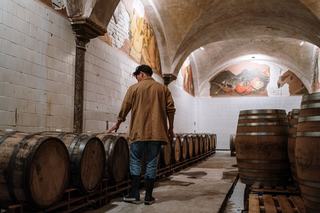
Burgundy keeps its wine under the streets: in Beaune, the vaulted cellars of the négociant houses sit below the town, usually down narrow stone stairs. The town centre is compact and flat, and several domaines on the Côte d'Or offer seated tasting experiences in a ground-floor room that bypass the cellar descent. In Champagne, the crayères of Reims and the cellars of Épernay lie deep in the chalk; a few houses have adapted their cellar tour route with lifts for visitors who cannot manage stairs, and these places are limited, so book well ahead.
How to book a wheelchair accessible wine tour
Booking a wheelchair accessible wine tour in France starts with a direct message to the estate, not with an online booking form. Most small family estates run tours on request, and the winemaker is often the guide: describing the chair (manual or electric, width), the number of people in the group and whether anyone can transfer to a standard seat lets the estate plan a route. The steps for reserving a French winery visit and its time slots are the same as for any visitor; only the questions differ.
- Ask whether the tasting room, the cellar and the restrooms are on one level, and if not, how the change of level is made.
- Ask about the surface between the parking spaces and the entrance: tarmac, paving or gravel.
- Check whether the guided tour is given in French and English, and whether a seated version exists.
- Confirm the booking in writing, with the access arrangements agreed.
Some estates and tourist offices list group tours with a minimum size, for example a booking required for 5 people minimum, with a contact name for accessibility questions. Specialist operators of accessible travel in France also run dedicated wine tours with adapted vans, which solves both the transport and the route questions at once. Choosing between a guided wine tour in France or driving yourself weighs differently for a wheelchair user: an adapted vehicle with a ramp and a driver who knows the estates removes most of the uncertainty.
Getting around: trains, cars and parking
Transport between vineyards is the part of an accessible wine trip that needs the most planning, because public transport rarely reaches the estates. SNCF runs a free assistance service, Accès Plus, for passengers with disabilities at stations, to be booked before travel; regional TER trains reach Bordeaux, Angers, Tours, Beaune, Reims and Épernay. From there, an adapted taxi or a wheelchair-accessible vehicle hire covers the last kilometres.
The European disabled parking card issued in another EU country is recognised in France, as is the French CMI stationnement card (carte mobilité inclusion), which replaced the earlier disability parking card in 2017. It gives access to reserved parking spaces in town centres and at many visitor sites. Several companies offer wheelchair hire in the large cities for travellers who prefer not to fly with their own chair.
Choosing a vineyard near Paris or a day trip by train
A vineyard near Paris is the simplest option for a visitor who wants a single day of wine tourism without a hotel change. Champagne is the closest wine region, about an hour from Paris by TGV to Reims, and the city centre around the cathedral is flat and paved. Further south, a day trip to the Loire by train reaches Tours or Angers in under two hours, with vineyard estates a short adapted taxi ride from the station. In each case, choose one vineyard for the morning and one for the afternoon at most: transfers, lifts and paths take longer than the timetable suggests, and a relaxed vineyard visit with a seated tasting is worth more than a third rushed stop. The vineyard landscape itself can be enjoyed from a car on the small roads of the Médoc or the Côte d'Or, where many vineyard plots line the road.
Experiences for visually impaired and hearing impaired visitors
Wine tasting suits visually impaired visitors particularly well, since smell, taste and touch carry most of the experience. Some estates with the Tourisme & Handicap visual pictogram offer tactile displays (grapes, cork, oak staves, soils) and an audio or spoken guided tour that describes the vineyard and the cellar. Museums play the same role: several wine museums in France with tactile exhibits are labelled for visual impairment and give the context a guide cannot always show.
For hearing impaired visitors, the hearing pictogram of the label indicates written support, induction loops at the reception or tours in French Sign Language (LSF). Tours in LSF are rare and are usually organised on a set date by a tourist office or a museum, so the cultural activities calendar of the region is the place to look. A written tasting sheet, handed out at the start, helps any visitor follow a tasting given in fast French.
Travelling with family, carers and assistance dogs
Many visitors with disabilities travel with family or a carer, and estates that welcome children usually have the wide paths, ground-floor rooms and patient pace that also suit a wheelchair. The estates listed for winery visits with children are a useful shortlist to check for step-free access. French law gives assistance dogs and guide dogs access to places open to the public, wine estates included, though a dog may be kept out of a working winemaking area for hygiene reasons: say in advance that a dog will come.
Accompanying carers sometimes enter museums and sites for free or at a reduced rate; the conditions vary from one site to another and are shown on the ticket office page. People with disabilities holding a CMI card can mention it when booking.
Wheelchair accessible winery tours: booking, cellars and assistance dogs
Can a wheelchair user visit a French wine cellar?
Yes, in many estates: in Bordeaux the chais are usually at ground level, in the Loire many tufa caves are entered on the flat, and in Champagne some houses use lifts. Where the cellar is only reached by stairs, the estate can offer a seated tasting above ground.
How far ahead should an accessible wine tour be booked?
Book at least two weeks ahead in high season, and longer for Champagne houses with a limited number of adapted cellar tour places or for a group with an adapted van. Smaller estates can often answer within a few days.
Which label shows that a winery is accessible to disabled visitors?
A French state label, Tourisme et Handicap, shows which of the four disabilities (motor, visual, hearing, mental) an estate is equipped for. The motor pictogram is the one that matters for wheelchair users.